

by Alison Bohlen
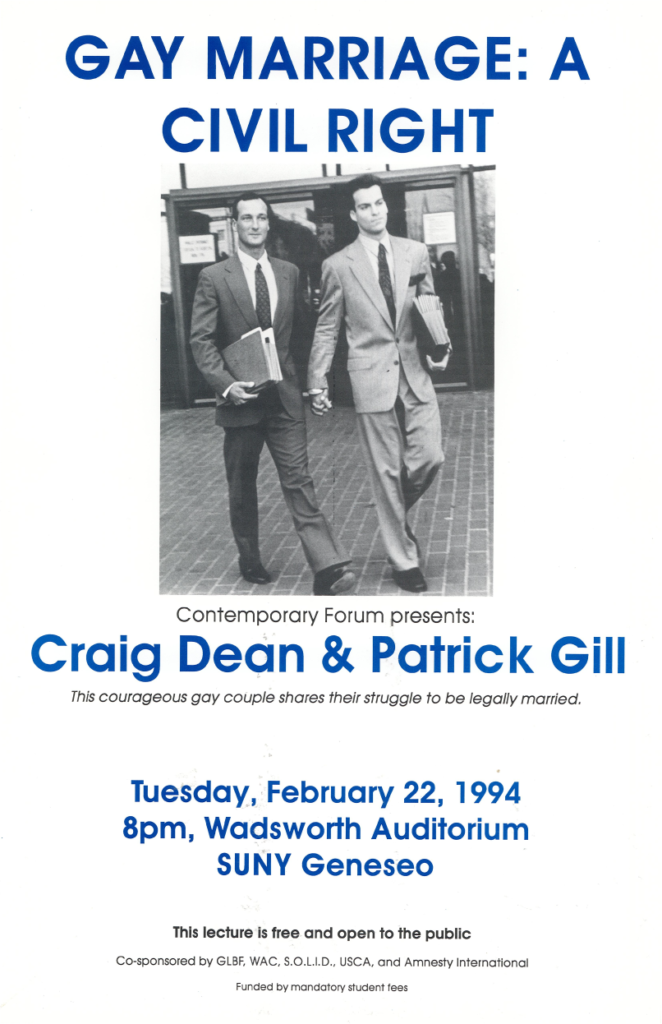
Craig Dean and Patrick Gill — 1994 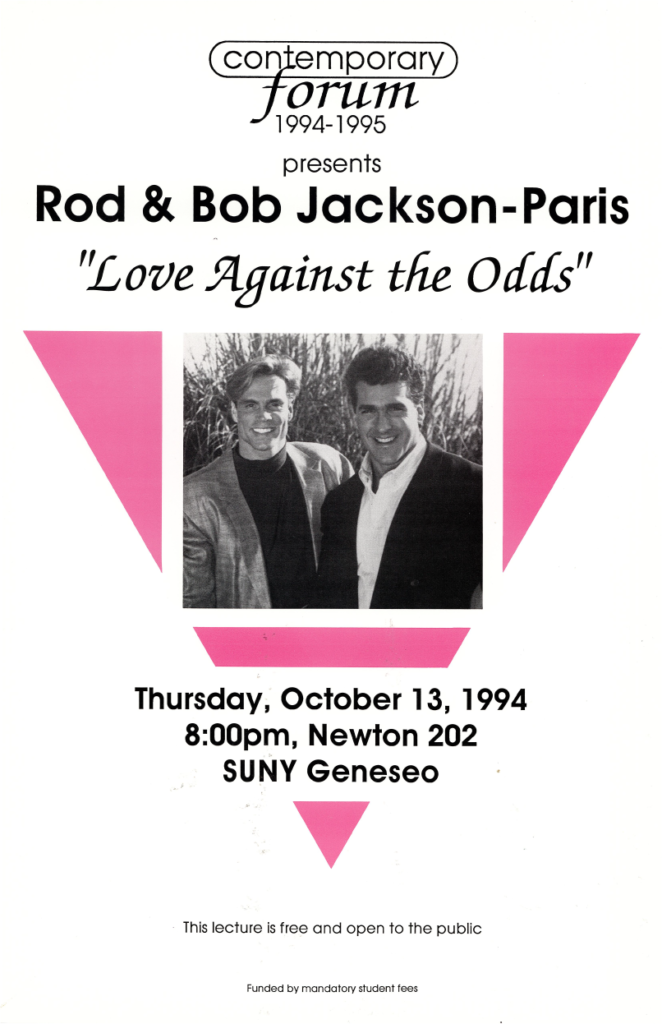
Rod and Bob Jackson — 1994 
The Flirtations — 1996
Have you ever seen the movie Philadelphia? Yes, the one with Tom Hanks in it! This movie provided one of the biggest stages for the a cappella group The Flirtations, who appeared at Andrew’s Costume Party! The Flirtations were widely active from 1988-1997 and SUNY Geneseo was lucky enough to get them to perform here on April 16, 1996. What made them different from other a cappella groups was that all the members were openly gay. Not only were they a fantastic acappella group but they were also activists who sought to send a message through their music.
Michael Callen started the Flirtations in the 1980s, with original members Jon Arterton, Aurelio Font, TJ Myers, and Cliff Townsend. Their music provided an opportunity for both a celebration of gay culture and a call to arms in the battle against AIDS and homophobia. It was fitting when the group appeared in the movie Philadelphia. This movie was the one of the first Hollywood films to address the widespread issues of HIV/AIDS, homophobia, and discrimination. The popular song “Everything Possible” was one of the Flirtations’ hits. In the song, the lines “You can be anybody that you want to be, You can love whomever you will” were very moving for those who were going through a tough time expressing their sexuality. This group was not only spreading awareness about AIDS but two members in the group actually had AIDS. Sadly, Callen and Meyers both died from the disease. This was a major problem in the LGBTQ community during the 1990s becasue it seemingly gave more reasons to be against same sex unity. Not only did the Flirtations stand for a cause but they also were a fantastic acapella group. In the 1900s acappella was growing, with famous groups such as Rockapella. The difference was that the Flirtations were doing what they loved, being openly gay and singing about it. Their dedication to singing and spreading awareness by doing what they loved made their audience feel joy. When you think about activists you think about a person/people having strong opinions and just voicing them. The Flirtations were creating songs that people were able to sing along to. The power people in the LGBT community must have felt, when singing along with the Flirtations, must have been profound.
As the Flirtations’ history suggests, being gay in the 1990s was definitely not easy. As the AIDS epidemic continued to disproportionately impact people in the LGBTQ community, the US government passed legislation curtailing the rights of LGBTQ individuals. For example, “Don’t Ask, Don’t Tell” was enacted in December 1993. This policy prohibited openly gay, lesbian, or bisexual persons from serving in the military. Approximately three years later, in September 1996, President Bill Clinton signed the Defense of Marriage Act (DOMA) into law, officially defining marriage as a union of one man and one woman. Despite such laws, there were fierce advocates within and for the LGBTQ community. Some of these advocates made appearances on SUNY Geneseo’s campus. In addition to the Flirtations, Rod & Bob Jackson-Paris and Craig Dean and Patrick Gill came to SUNY Geneseo in the 1990s, addressing students on the topic of LGBTQ rights.
While “The Flirtations” sang about the discrepancies the people of this community had, Rod and Bob Jackson- Paris spoke about it. They were the “it” couple of the 1990s, who came to SUNY Geneseo in October of 1994, appearing for a fee of $4,000. Bob who was Mr. Universe, the IFBB World Bodybuilding Champion, and the first ever male professional athlete to come out. Bob coming out as gay made a huge impact on his career and life. In fact, many companies who signed him for photoshoots and contracts wanted to back out because they were not okay with his sexuality. He also received countless death threats. Rod was amateur bodybuilder and a Playgirl model, who was not as famous as his partner Bob but still had enjoyed some spotlight. Not only were these two men known for their impeccable looks and crazy achievements, but they were known for being the biggest gay advocates in the 1990s. This couple started publicly speaking about the inside of their relationship, discussing all of the hate and discrimination they had experienced after coming out. With the outbreak of AIDS, people (especially young adults) felt trapped in their own skin. Also since, gay marriage has not been legalized yet, it was an even harder time because the community still did not have equal rights. Their visit to SUNY Geneseo was pivotal time to be talking about gay rights, and it laid a path for later years. They tried to make the issues that they have encountered promanante, spread awareness to try and prevent it and show people that they can be themselves. This visit made students, particularly those who were members of the LGBTQ community, feel like they were not alone.
Have you ever wondered why gay marriage wasn’t fully legalized until 2015? Craig Dean and Patrick Gill thought the same thing. That’s why in November of 1990 they tried to get a marriage license in the state of Washington. When they were denied, they were furious. They filed a lawsuit against the City of Washington in 1993. Shortly after this they came to SUNY Geneseo, appearing on February 22, 1994 to continue advocating for gay marriage.
Their journey as advocates began when Patrick Gill contracted AIDS-and was rushed to the hospital. Craig Dean, shortly behind him to be by his side, was not allowed to see him because they were technically not “family” since they were not married. Since that very day, these two men started their journey to trying to get gay marriage legalized and to advocate for the rights of people in this community. In 1993, Dean and Gill had what was headlined as the largest gay marriage ceremony which is known as the March on Washington for the LGBTQ community. When they later sued the city of Washington, after a long case back and forth whether or not to legalize gay marriage, it came to a devastating ending for this couple and every gay relationship. They lost the case. Yet they still fought. “It all started because Pat and I love each other,” says Dean. “A marriage license is important because it’s going to protect our relationship within and without. By not fully asserting ourselves and trying to get the license, we would be agreeing with society that our relationship is less than other marriages. We would be giving in to our own homophobia.” Unfortunately, not only did Dean lose the case but he lost his partner, Patrick, to AIDS 2 years later. After their case, there was movement on the legalization of gay marriage, but not in a good way. DOMA was enacted in 1996 and defined marriage, at the federal level, as the union of one man to one woman. Before this, federal law did not specifically state a man and a woman. Although, this was enacted in 1996, not even 10 years later, Massachusetts legalized gay marriage in 2004. Dean eventually fell in love with a man named John Blevins, whom he married right when it became legalized. This all happened because Craig Dean and Patrick Gill set a stepping stone for other things to happen in order for gay marriage to be legalized.
These groups that came to SUNY Geneseo in the 1990s made such a big impact on the students that go here. Those who are in the LGBTQ community had a sense of security because hearing people talk/sing about the problems that they were encountering made them feel like they were not alone and they had support. For those students who are straight, hearing about the problems others endure may open their eyes and make changes to their views. The controversies in this time period definitely swayed people who were not in the community’s opinions. Everyone, whether straight or gay, would be able to come out of these performances with more information they might have not known. These amazing groups helped reduce the hate that some may be going through and built up a support system for people who needed it. Educational aspects, such as the awareness of AIDs, made an impact on students and gave them knowledge of what was going on in the world around them. Jackson-Paris, Dean and Gill, and the Flirtations taught students to keep doing what they love and to not give up when things get hard. That’s why in the 1990s it was such an important time for them to come.