

by Joey Morgan
The Eagles – a renowned rock band still to this day – went on hiatus at many points throughout the course of their career, yet they also always seemed to find their way back to one another. Influenced by 1960s rhythm and blues, soul, bluegrass, and rock bands such as the Byrds and Buffalo Springfield, the Eagles’ overall sound has been described as “California rock.” The idea of naming the band “Eagles” came during a peyote and tequila-influenced group outing in the Mojave Desert, a fitting story for their unique sound. Released in 1972, Eagles was the band’s breakthrough success, yielding three Top 40 singles. For their next album, On the Border, members Don Henley and Deacon Frey wanted the band to break away from the country rock style and move more towards hard rock. Continuing on this path, The Eagles released their fourth studio album, One of These Nights, in 1975. A breakthrough album for the Eagles, making them international superstars, it was the first in a string of four consecutive number 1 albums. In early 1976, the band released their first compilation album, Their Greatest Hits (1971–1975). The album became the highest-selling album of the 20th century in the United States, and it remained so until it was taken over by Michael Jackson’s Thriller following Jackson’s death in 2009. The album cemented the group’s status as the most successful American band of the decade. Eventually, Hotel California topped the charts and was nominated for Album of the Year at the 1978 Grammy Awards, but lost to Fleetwood Mac’s Rumours — but imagine competing against Fleetwood Mac!
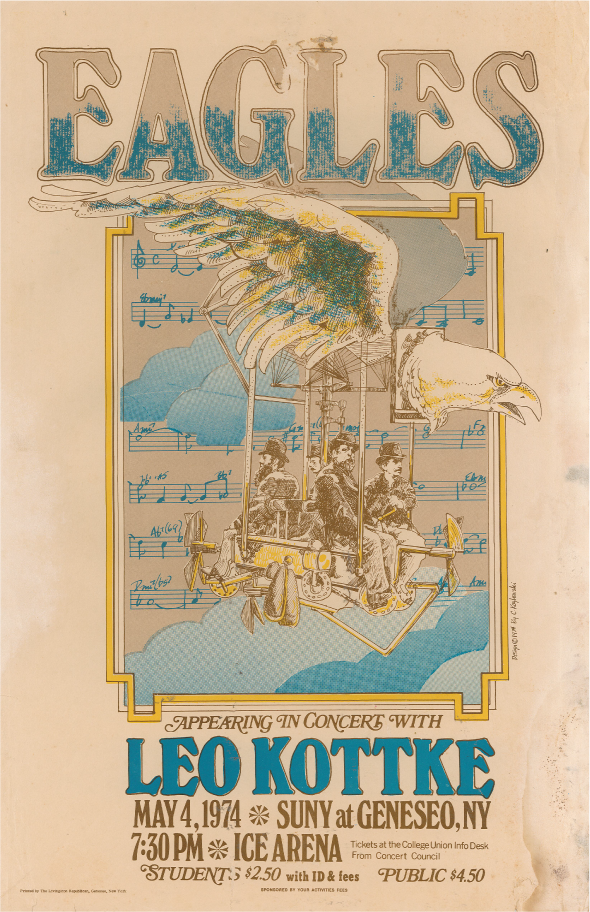
The Eagles performed in 1974 in the Wilson Ice Arena, near the beginning of their stardom. The timeline proves Geneseo’s luck and somewhat of an intuition into booking the best of the best. Tom Matthews and a large crew of students throughout the years got their hands on performers like Billy Joel, Kool and the Gang, Art Garfunkel (from Simon and Garfunkel), and Steve Martin. Keep in mind, those are only a smattering of performers – and only from the 70s! In retrospect, the Eagles’ performance in Geneseo is amazing. In a 1974 issue of the Geneseo student newspaper The Lamron, a writer noted that the Eagles were “an extremely capable band who, in my opinion, have perhaps the most promising future of any rock band generated thus far by the Seventies.” Not to mention, it was only $2.50 to see them.
The Eagles’ timelessness is documented and demonstrated through an acclaimed two-part documentary. The Emmy Award-winning film features rare archival material, concert footage, and never-before seen home movies that explore the evolution and enduring popularity of one of the world’s biggest-selling and culturally significant American bands. The first part is around two hours long and covers early periods of their development, all the way to their breakup. The second part is about one hour long and covers the subsequent periods. The documentary combined archive footage of the band with interviews with all the members of the band, as well as other people involved in the band history or who knew them, such as Kenny Rogers, Bob Seger, Linda Ronstadt, Jackson Browne, and Stevie Nicks.