by Joey Morgan
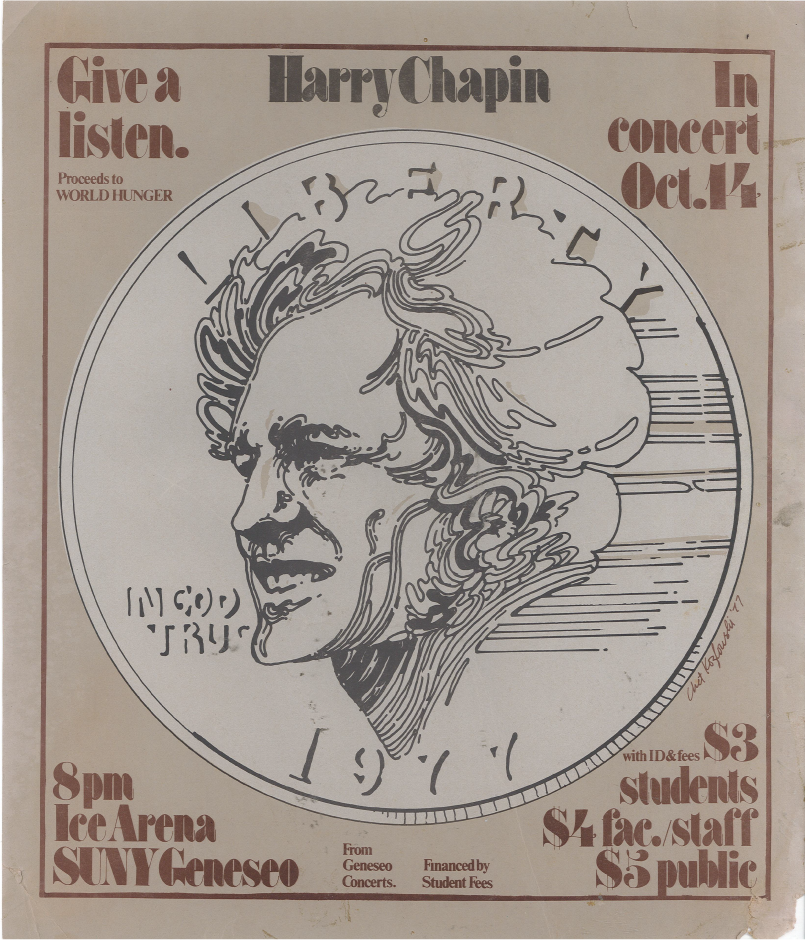
Harry Chapin (1942-1981) was a popular singer who achieved worldwide success in the 1970s, not only for his folk-rock but also for his philanthropy and hunger activism. His brother, Tom Chapin, continues to support a nonprofit organization co-founded by his brother called WhyHunger (formerly World Hunger Year). In fact, Tom Chapin sits on WhyHunger’s Board of Directors. Harry and Tom Chapin began performing with one another when they were teenagers, with their father occasionally joining them on drums. Harry eventually signed onto a contract in the early seventies, which was one of the biggest of its time. It granted him free recording time, along with many other perks. The same year, he released his album Heads & Tales, which eventually became an international hit. In 1974, Chapin released his most successful album, Verities and Balderdash. One of the most popular songs from the record, “Cats in the Cradle,” and other hits, led him to be nominated for the Grammy Award for Best Male Pop Vocal Performance. In 2011, he was inducted into the Grammy Hall of Fame for “Cats in the Cradle,” a song that is still familiar to many today. The song tells the story of a father who doesn’t find time for his son during the boy’s childhood; ultimately the son grows up to be just like his father, not making any time for his dad. Although this is the story portrayed by the song, the Chapin family seemed to be close knit, suggesting that in this case, Harry was not writing from personal experience.
Tom Matthews, who enjoyed a long tenure working at SUNY Geneseo’s, recollects fondly on Harry and his brother Tom Chapin, both performers at Geneseo:
Harry’s younger brother, Tom, went to Plattsburgh at the same time as I did. He was our star basketball player! Tom later hosted a children’s show “Make A Wish” on ABC from 71-76 and published children’s books,” attesting to Tom Chapin’s character. Tom Matthews goes on to say, “He brought his older brother Harry to do an informal concert one Sunday afternoon. It was early in the folk music era. I loved the show and when I came to Geneseo, I convinced our student lead activities to bring the Chapin Brothers for a concert,” referring to their performance in 1971 in Macvittie Ballroom. “They were a big hit and after Harry became a star attraction, we brought him back at least 3 times, including during his World Hunger Tour that was, and still is, a major charity supported by the Chapin family. We also brought him back as a commencement speaker and I remember Harry leading the entire audience in All My Life’s a Circle. Harry was killed in early July, right after our commencement. I had the honor of presenting him an award from the National Association for Campus Activities when I was board chair in 1976. One of my best speeches ever in my career was a Memorial Tribute to Harry Chapin at a NACA convention. The story I told the class was about the piano tuner not showing up to tune the grand piano in the Ice Arena. Steve Chapin was his pianist and was very fussy about making sure the piano was properly tuned. A student on the tech crew or concert committee pretended to tune the piano and Steve was fine with the results and the show was incredible. I think it may have been Harry’s last performance at Geneseo”
Tom Matthews
Tom and Harry Chapin’s impacts are evident in Tom Matthews’ recollection, and would only be further supported if more memories were to be shared by students. Their influences over Geneseo as a whole can be felt deeply by the stories of but one person. More than half of Chapin’s concerts were benefit performances (for example, a concert to help save the Landmark Theatre in Syracuse, New York, as well as hunger causes such as food banks), and proceeds from his concert merchandise were used to support World Hunger Year. One report quotes Harry Chapin’s widow saying soon after his death — “only with slight exaggeration”– that “Harry was supporting 17 relatives, 14 associations, seven foundations, and 82 charities. Harry wasn’t interested in saving money. He always said, ‘Money is for people,’ so he gave it away.” Despite his success as a musician, he left little money and it was difficult to maintain the causes for which he raised more than $3 million in the last six years of his life. The Harry Chapin Foundation was the result.